
Here I am in my isolette after my PDA ligation. The white patch on the
left side of my back is where they made the incision.
One of my first surgeries was a PDA ligation. The nurses and doctors would hear murmurs in my heart and I was having trouble breathing on my own. This was the reason why Dr. Bixby felt strongly about transferring me to CHOC: so that they could perform the surgery. The medication, indomethacin, that they were giving me wasn't really working to close the PDA so the only other option was to surgically fix it. It sounded scary at first but we were told that it was a very common procedure that the doctors do a lot, especially on us preemies. The procedure went by so fast that mommy and daddy didn't even make it to the hospital in time today. The surgery was performed under general anesthesia and I was able to keep breathing through the ventilator that I was already hooked up to. To reach the PDA, my surgeon, Dr. Grant, made a small incision on the left side of my back, lifted up my tiny lung, and closed the valve with a tiny clip (which will stay on permanently). Sounds crazy, doesn't it?? It's just amazing what doctors are capable of doing on such tiny human beings! Technology has come a long way, yes? Mommy and daddy were able to talk to the surgeon afterwards about how quick and successful the surgery was. What a relief! Hopefully this will help me get off the ventilator...soon!
(The following are some info on PDA)
What is patent ductus arteriosus (PDA)?
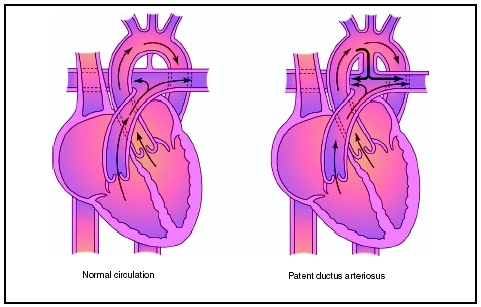
Patent ductus arteriosus (PDA) is a condition in which the connecting blood vessel between the pulmonary artery and the aorta in fetal circulation, called the ductus arteriosus, stays open in a newborn baby. Because the placenta does the work of exchanging oxygen (O2) and carbon dioxide (CO2) through the mother’s circulation, the fetal lungs are not used for breathing. Instead of blood flowing to the lungs to pick up oxygen and then flowing to the rest of the body, the fetal circulation shunts (bypasses) most of the blood away from the lungs. In the fetus, blood is shunted from the pulmonary artery to the aorta through the ductus arteriosus. However, with the first breaths of air the baby takes at birth, the fetal circulation changes. A larger amount of blood is sent to the lungs to pick up oxygen. Because the ductus arteriosus is no longer needed, it normally begins to wither and close off.
Causes of patent ductus arteriosus?
Some babies are more likely to have a PDA, especially premature babies. Babies with respiratory problems at birth may have a difficult time increasing the pressure inside the lungs and changing the blood flow. A PDA is also a common congenital heart defect. It is twice as common in females as in males.
Why is it a concern?
Problems are more likely to occur if the opening of the PDA is large. It causes too much blood to flow to the lungs and not enough to the other parts of the body. There can be changes in blood pressure, this can cause heart enlargement as the heart tries to make up for the abnormal blood flow. Severe PDA can cause slow growth, and may result in heart failure. In premature babies, PDA can complicate respiratory problems, making the distribution of oxygen more difficult.
The symptoms of patent ductus arteriosus:
Babies with small PDAs may not have any observable symptoms. The following are the most common symptoms of PDA:
-strong pulses
-heart murmur
-enlarged heart size
-respiratory difficulty
-cyanosis (blue coloring)
How is it diagnosed?
*electrocardiogram - a test that records the electrical activity of the heart, shows abnormal rhythms and, detects heart muscle damage
*x-ray - a diagnostic test which uses invisible electromagnetic energy beams to produce images of internal tissues, bones, and organs onto film
*echocardiogram - a noninvasive test that uses sound waves to produce a study of the motion of the heart’s chambers and valves
*cardiac catheterization (when other heart defects are suspected) - a test in which a small catheter (hollow tube) is guided through a vein or artery into the heart to help see any defects on x-ray
Treatment of patent ductus arteriosus:
Treatment is based on a few factors:
-your baby’s gestational age, overall health, and medical history
-extent of the disease
-your baby’s tolerance for specific medications, procedures, or therapies
-expectations for the course of the disease
-your opinion or preference
Small PDAs may not require treatment or may close without treatment. In premature babies, an aspirin-type drug called indomethacin is often given. Indomethacin has been shown to cause a PDA to close. Further studies are being done to find out if it will also help prevent PDA in babies. If a PDA does not respond to medication, or is due to causes other than prematurity, surgery may be needed. This surgery is called ligation and involves placing a suture around the ductus to close it.


No comments:
Post a Comment